


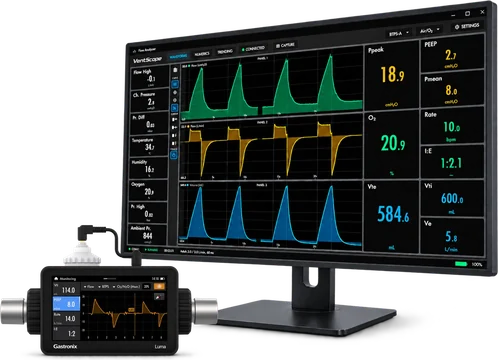
A ventilator has to deliver what its screen says it delivers. A performance verification proves that, with instruments that are more accurate than the ventilator itself. It is done before a ventilator goes into service, after a repair, and at the interval the manufacturer and your hospital's policy set.
This guide describes the general idea. The exact test points, tolerances and sequence always come from the ventilator manufacturer's service manual and from the standards your organisation follows, for example ISO 80601-2-12 for critical care ventilators and ISO 80601-2-13 for anaesthetic workstations.
What you need
A verification setup has three parts:
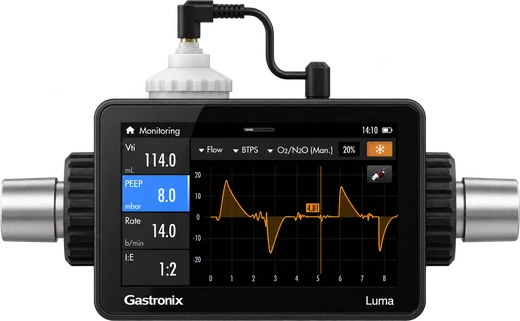
- A gas flow analyzer to measure what the ventilator really delivers: flow, pressure, volume and oxygen concentration. The LUMA gas flow analyzer measures flow 0–250 sL/min, pressure 0–10 bar and oxygen 0–100 %, with compensation for air, O₂ mixtures, N₂O, CO₂ and heliox.
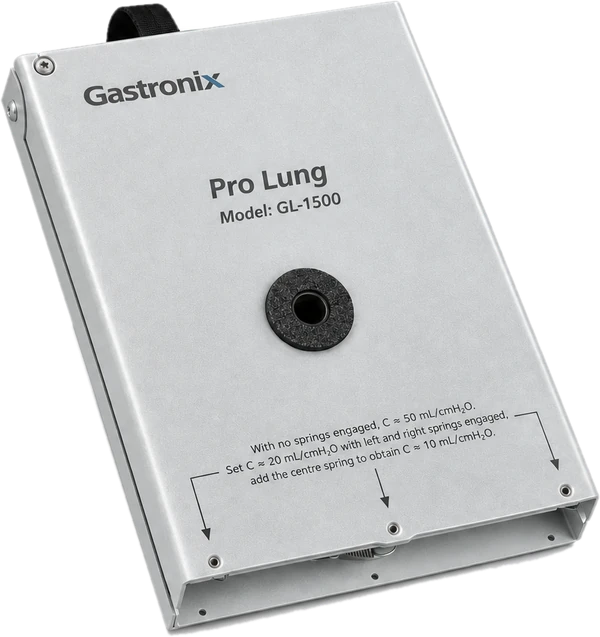
- A test lung to give the ventilator a known load in place of a patient. The GL-1500 test lung offers three compliances (0.5, 0.2 and 0.1 L/kPa, about 50, 20 and 10 mL/cmH₂O).
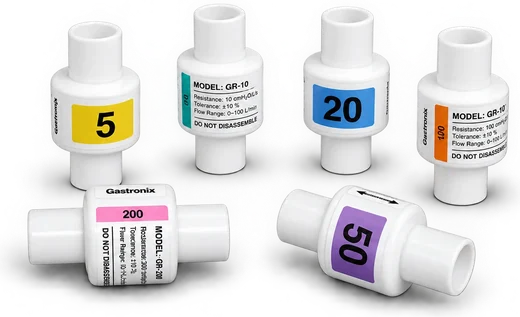
- Calibrated resistances to add a known airway resistance in front of the lung. The GR Series covers six values from 5 to 200 cmH₂O/L/s.
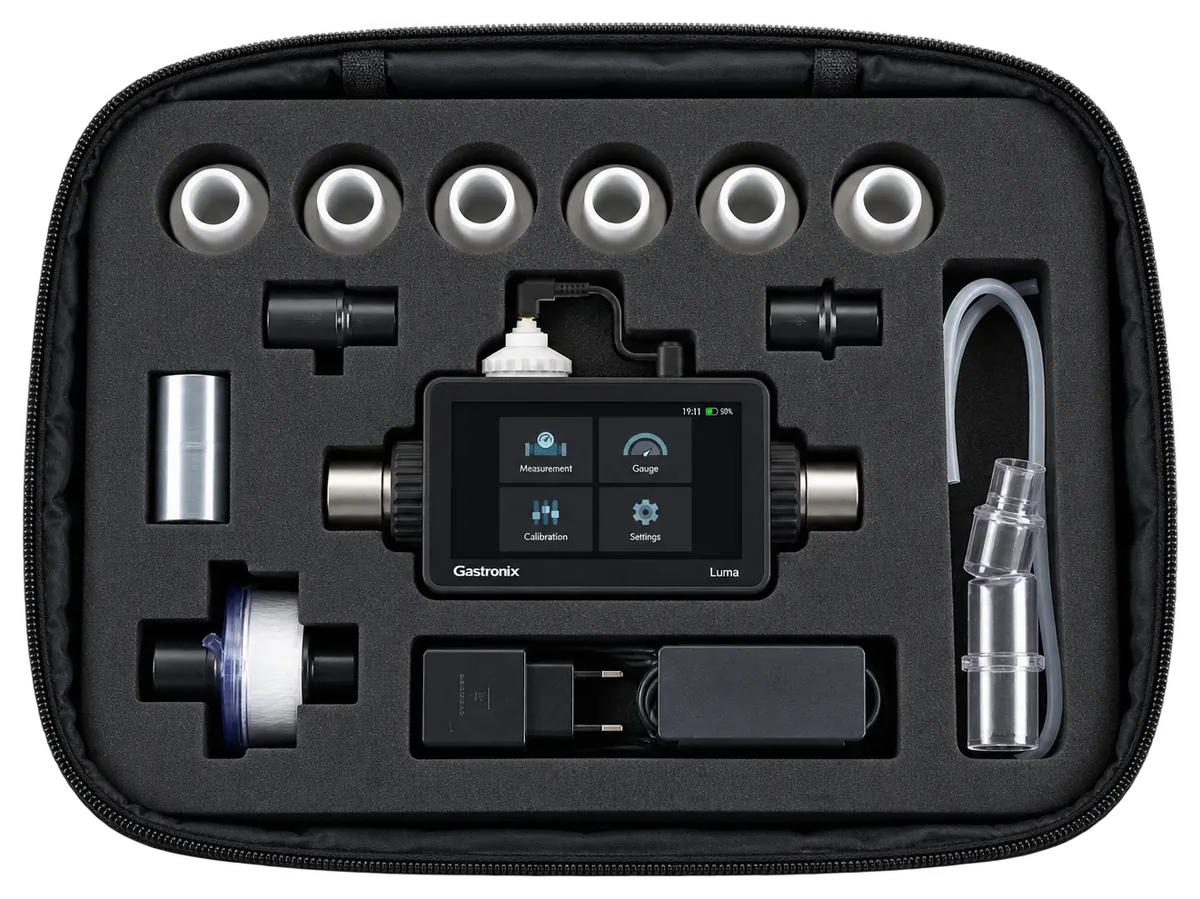
The analyzer and the six resistances also come together in one case as the Pro Kit.
What you measure
Typical checks, with the ventilator set to known values and connected to the test lung:
- Delivered tidal volume and flow against the set value.
- Airway pressure, including peak pressure and PEEP.
- Breath rate and I:E ratio.
- Oxygen concentration against the set FiO₂.
- Behaviour with different loads: different compliances and resistances, because a ventilator that is right on one setting can be off on another.
For each check you note the set value, the measured value and the tolerance. A result outside the tolerance means the ventilator needs adjustment or service before it is used.
Keep the record
A verification is only useful if you can show it later. Record the date, the ventilator and its serial number, the instruments used with their serial numbers, the measured values and who did the check. Your analyzer, test lung and resistances should each have a current calibration certificate, so the measurements can be traced back to a reference. Every Gastronix instrument is delivered calibrated, with a calibration certificate with full data.
Do not skip the instruments' own calibration
The check is only as good as the instruments. They also drift, so they go back for calibration at regular intervals. Gastronix offers a calibration service for its own instruments.
Looking for the instruments? See the Webstore or write to customerservice@gastronixlab.com.