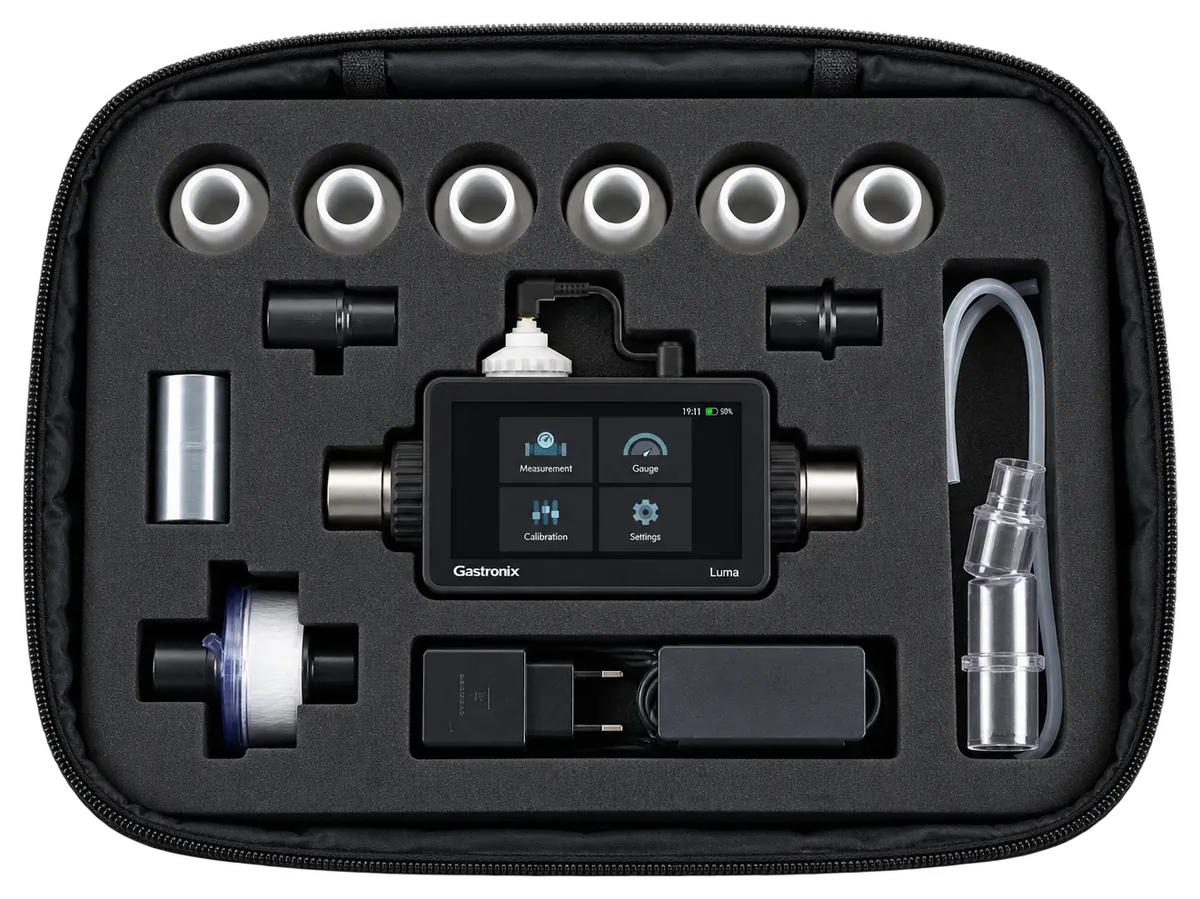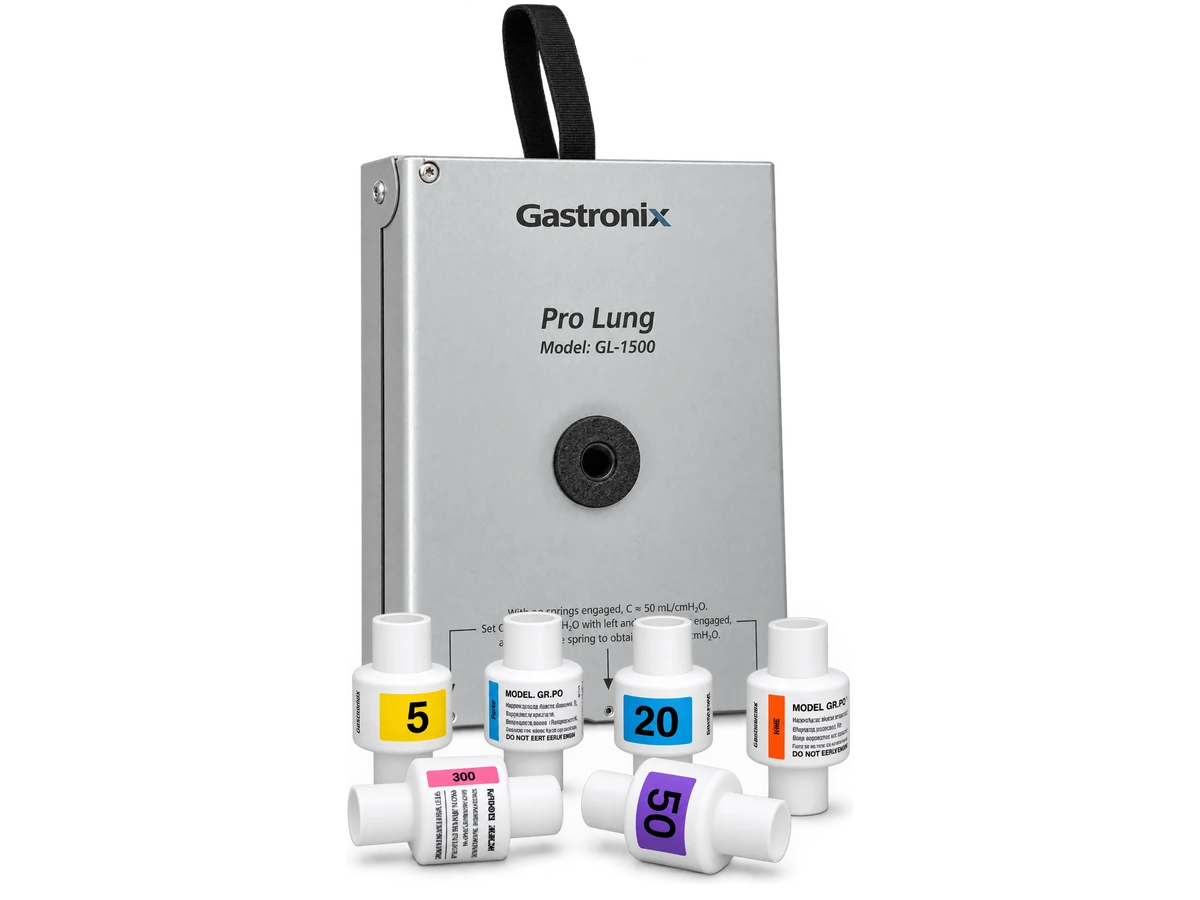



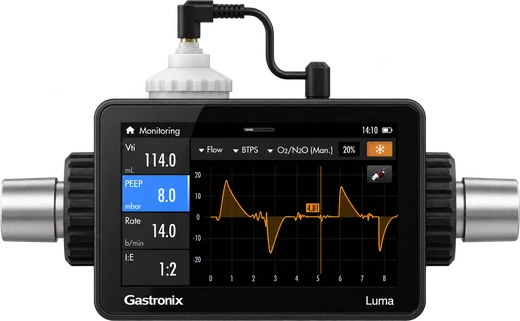
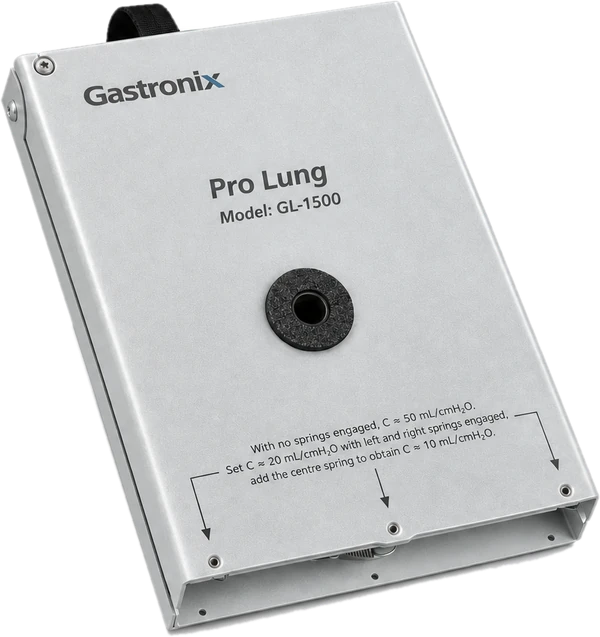
ISO 80601-2-12 (critical care ventilators) asks the manufacturer to show that a ventilator delivers the volume or pressure it is set to, into lungs of different stiffness and airway resistance. This guide covers ten of the standard's bench set-ups, five volume-control and five pressure-control. This guide lists them and shows how to run them with the Gastronix GL-1500 test lung, the GR Series resistances and the LUMA gas flow analyzer.
The tables below follow ISO 80601-2-12:2023, Tables 201.104 (volume control) and 201.105 (pressure control). Always read the clause itself and the ventilator's instructions for use before you rely on a result.
The bench
The ventilator's patient connection port goes to the LUMA, then to a calibrated resistance, then to the test lung (Figure 201.102 of the standard). Nothing else sits between them.
- Test lung: the GL-1500 has three compliances. 50 ml/hPa has no springs engaged, 20 ml/hPa has two, and 10 ml/hPa has three (0.5, 0.2 and 0.1 L/kPa).
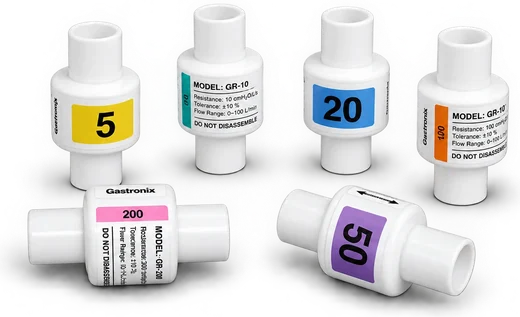
- Resistance: a GR resistance in the value the row asks for (5, 10, 20 or 50). Each GR carries its value on a colour-coded label: 5 olive, 10 teal, 20 blue, 50 purple, 100 orange, 200 pink.
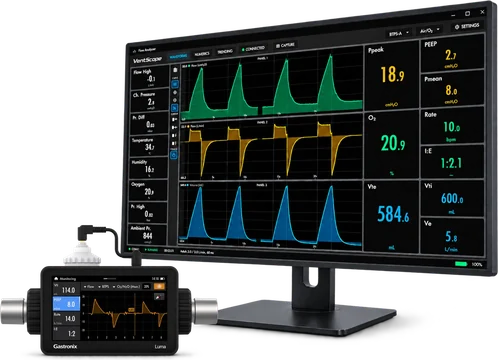
- Analyzer: LUMA at the patient connection port, with flow, pressure and oxygen channels. For volumes, set the gas standard to the breathing-system condition (BTPS) and the gas mixture to air/O₂.
Resistance in the standard is written in hPa·s/l. The GR Series is labelled in cmH₂O/L/s. The standard treats the two as interchangeable (1 hPa is 1.02 cmH₂O), and so does this guide.
The five volume-control rows
| # | Compliance (ml/hPa) | Resistance | Tidal volume | Rate | Insp. time | I:E | FiO₂ | PEEP |
|---|---|---|---|---|---|---|---|---|
| 1 | 50 | 5 | 500 ml | 20/min | 1 s | 1:2 | 30 % | 5 hPa |
| 2 | 20 | 5 | 500 ml | 20/min | 1 s | 1:2 | 90 % | 5 hPa |
| 3 | 20 | 20 | 300 ml | 20/min | 1 s | 1:2 | 30 % | 5 hPa |
| 4 | 10 | 50 | 300 ml | 20/min | 1 s | 1:2 | 90 % | 10 hPa |
| 5 | 10 | 10 | 200 ml | 20/min | 1 s | 1:2 | 90 % | 5 hPa |
The bench for each row, in the same order as the table:





The five pressure-control rows
| # | Compliance (ml/hPa) | Resistance | Δ pressure above PEEP | Rate | Insp. time | I:E | FiO₂ | PEEP |
|---|---|---|---|---|---|---|---|---|
| 1 | 50 | 5 | 10 hPa | 20/min | 1 s | 1:2 | 30 % | 5 hPa |
| 2 | 20 | 5 | 25 hPa | 20/min | 1 s | 1:2 | 90 % | 5 hPa |
| 3 | 10 | 10 | 25 hPa | 20/min | 1 s | 1:2 | 30 % | 10 hPa |
| 4 | 50 | 20 | 15 hPa | 12/min | 1 s | 1:4 | 90 % | 10 hPa |
| 5 | 20 | 50 | 25 hPa | 12/min | 1 s | 1:4 | 90 % | 10 hPa |
The bench for each row, in the same order as the table:





I:E follows from the rate and the inspiratory time: at 20/min the cycle is 3 s, so 1 s in and 2 s out is 1:2; at 12/min the cycle is 5 s, so the ratio is 1:4. In pressure control the volume is an outcome of the pressure you set, so it is recorded but not judged against a set-point.
Running one row
- Build the bench for the row (lung compliance, resistance value) and connect it as in the figure.
- If the ventilator applies compliance correction, determine or enter the breathing-system compliance and activate it. Fill any humidifier to its maximum level first.
- Apply the ventilator settings from the table. In pressure control, set the Δ pressure above PEEP and a rise time that lets the pressure be reached within the inspiratory time.
- Wait for steady-state conditions.
- Read the delivered tidal volume by integrating the flow signal at the patient connection port. Read PEEP as the average airway pressure over the last 50 ms of expiration. In pressure control, read the airway pressure at the end of inflation as the average over the preceding 50 ms.
- Hold the condition for 30 consecutive inflations before you accept the row.
What counts as a pass
The standard does not fix one limit for everything. It requires the manufacturer to state the maximum bias and linearity error of volume and pressure delivery in the instructions for use (clauses 201.12.1.101 a) and 201.12.1.102 a), with examples such as ±(5 ml + 10 % of the set volume) and ±(3 hPa + 5 % of the set pressure)). Your acceptance limits for a given ventilator are therefore the figures in its own instructions for use. The standard does fix some limits elsewhere, for example for monitored volumes, but those compare the ventilator's display with the reference, and they are not part of this bench test.
Recording the results
Ten rows with five to eight readings each is a lot to write down. In VentScope the Reports tab takes the readings straight from the analyzer, judges each against the limits you enter for the ventilator under test, and builds a PDF report. See "Recording and reporting test results in VentScope".
Instruments: LUMA gas flow analyzer, GL-1500 test lung, GR Series resistances, or all together in the Pro Kit and the Lung Simulator Kit.